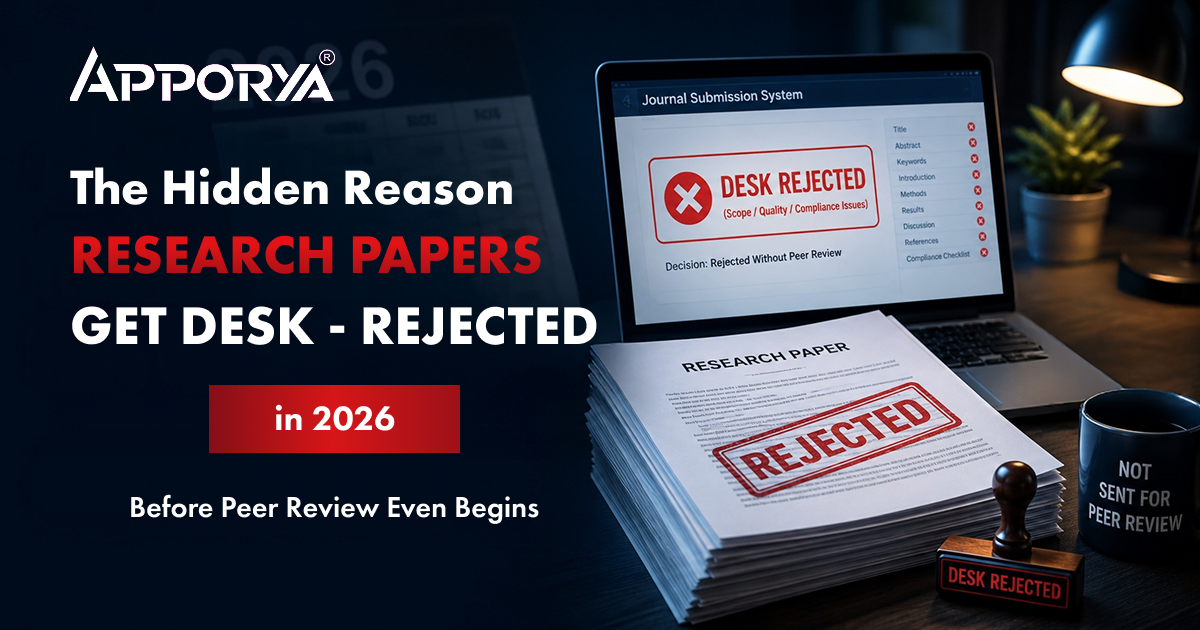
Many researchers believe that journal rejection happens after peer review.
In reality, thousands of research papers never even reach reviewers.
They are rejected by editors within days—or sometimes hours—of submission.
This process is known as desk rejection, and in 2026 it has become one of the biggest obstacles facing PhD scholars and academic researchers.
A researcher may spend months conducting experiments, writing manuscripts, and formatting references only to receive a brief email stating:
“The manuscript is not suitable for further consideration.”
No reviewer comments.
No detailed explanation.
Just rejection.
Understanding why this happens is now essential for publication success.
What Is a Desk Rejection?
A desk rejection occurs when a journal editor decides that a manuscript should not proceed to peer review.
The decision is usually made during the initial editorial screening process.
Editors examine:
- Scope alignment
- Research novelty
- Methodology quality
- Writing clarity
- Ethical compliance
- Reference quality
- Formatting standards
If significant issues are identified, the paper is rejected immediately.
Major publishers increasingly use automated screening systems combined with editorial evaluation to filter submissions before peer review begins.
Why Desk Rejections Are Increasing in 2026
The academic publishing landscape has changed dramatically.
Several factors contribute to rising rejection rates:
Increased Submission Volumes
AI-assisted writing tools have made manuscript preparation faster than ever.
As a result, journals receive significantly more submissions than before.
Editors must quickly identify papers that are unlikely to meet publication standards.
Higher Quality Expectations
Reviewers and publishers now expect:
- Strong methodology
- Genuine novelty
- Transparent research practices
- Ethical AI usage
Researchers who fail to meet these expectations often face immediate rejection.
The Top 7 Reasons Papers Get Desk-Rejected
1. The Research Lacks Clear Novelty
Novelty remains one of the strongest publication criteria.
Editors frequently ask:
- What new knowledge does this study provide?
- How does it advance the field?
- Why should readers care?
If the manuscript merely repeats existing findings, rejection becomes likely.
2. Poor Journal Selection
One of the most avoidable mistakes researchers make is submitting to the wrong journal.
A technically strong paper can still be rejected if it does not match the journal’s aims and scope.
Before submission, researchers should carefully review:
- Recently published articles
- Journal objectives
- Target audience
- Methodological preferences
For additional guidance, researchers can explore Apporya’s Research Support Services for journal-aligned research planning.
3. Weak Literature Review
Editors can quickly identify literature reviews that:
- Miss recent studies
- Lack critical analysis
- Depend excessively on AI-generated summaries
Strong literature reviews demonstrate academic understanding rather than simple summarization.
4. Methodology Concerns
Many manuscripts fail because the research design is not sufficiently robust.
Common issues include:
- Small sample sizes
- Weak statistical methods
- Missing validation procedures
- Inadequate data collection
Methodological weakness often signals larger reliability concerns.
5. AI-Generated Writing Patterns
Editors have become increasingly familiar with AI-generated manuscript structures.
Warning signs include:
- Generic language
- Repetitive sentence patterns
- Weak discussion sections
- Overly broad conclusions
Responsible AI assistance is acceptable, but scholarly interpretation must remain human-driven.
6. Poor English and Structure
Even excellent research can struggle if readers cannot understand it.
Common problems include:
- Long paragraphs
- Unclear transitions
- Inconsistent terminology
- Weak argument flow
Academic clarity remains a major publication requirement.
7. Ethical and Citation Issues
Editors carefully evaluate:
- Citation accuracy
- Plagiarism risks
- AI disclosure statements
- Research ethics approvals
Even minor ethical concerns can trigger immediate rejection.
How to Reduce Desk Rejection Risk
Researchers should complete a pre-submission audit.
Ask:
✓ Is the topic novel?
✓ Does the journal match my study?
✓ Is the methodology clearly explained?
✓ Are all references verified?
✓ Does the manuscript provide a clear contribution?
✓ Have AI-assisted sections been reviewed manually?
A structured review process dramatically improves acceptance potential.
A Publication Workflow That Works
Successful researchers often follow this sequence:
- Identify a genuine research gap.
- Conduct a comprehensive literature review.
- Build a strong methodology.
- Validate data and analysis.
- Improve academic writing.
- Select the right journal.
- Conduct a final publication readiness review.
This systematic approach significantly reduces desk rejection risks.
How Expert Research Support Can Help
Many scholars focus heavily on conducting research but spend insufficient time preparing manuscripts for publication.
Professional support can help with:
- Research gap identification
- Methodology validation
- Data analysis
- Journal selection
- Manuscript review
- Publication readiness assessment
Apporya’s publication support ecosystem helps researchers bridge the gap between research completion and successful publication.
Conclusion
Desk rejection is not random.
In most cases, it occurs because editors identify issues that could have been corrected before submission.
Researchers who understand editorial expectations, strengthen methodology, improve manuscript quality, and align their work with the right journals can significantly improve publication outcomes.
In 2026, publication success is not simply about conducting good research.
It is about presenting that research in a way that editors immediately recognize as publishable.