Introduction
For researchers, peer review can sometimes feel unpredictable.
You submit a manuscript after months of work.
Then the reviewers return comments such as:
- “The methodology requires clarification.”
- “The novelty is insufficient.”
- “The discussion does not adequately address previous literature.”
- “The conclusions are not fully supported by the results.”
Researchers often wonder:
Could artificial intelligence have identified these problems before submission?
The answer is increasingly yes—but with important limitations.
AI is entering different parts of scholarly publishing, including manuscript screening, editorial workflows and research-quality checks. Enago’s current Academy content specifically highlights AI readiness in peer review as an emerging publishing issue.
But AI is not replacing expert reviewers.
At least not in the way many headlines suggest.
What Is AI-Powered Peer Review?
AI-powered peer review refers broadly to using artificial intelligence to assist parts of the manuscript evaluation process.
Depending on the system, AI may help identify:
- missing information,
- language problems,
- citation inconsistencies,
- methodological concerns,
- statistical anomalies,
- similarity issues,
- reporting gaps,
- image irregularities,
- or potential conflicts.
The important word is assist.
A scientific publication decision still requires human responsibility and subject expertise.
What Can AI Detect Well?
AI can be useful for repetitive checks.
Language and Structure
AI systems can identify:
- unclear sentences,
- repetitive wording,
- inconsistent terminology,
- poor transitions,
- structural problems.
Reference Problems
AI-assisted tools can help identify:
- missing citations,
- inconsistent references,
- duplicated references,
- citation formatting problems.
But researchers should still verify references independently.
Reporting Completeness
AI can potentially identify whether expected information appears to be missing.
For example:
- sample size,
- study limitations,
- methodological details,
- statistical information.
Can AI Judge Novelty?
This is much harder.
A researcher may ask an AI system:
“Is my research novel?”
The answer may sound convincing.
But novelty is contextual.
A genuinely novel contribution may be hidden inside a very specialized subfield.
A human expert may understand:
- historical debates,
- methodological traditions,
- unpublished discussions,
- emerging research directions,
- and subtle differences between existing approaches.
AI can assist literature comparison.
It should not be treated as the final authority on novelty.
Can AI Predict Journal Rejection?
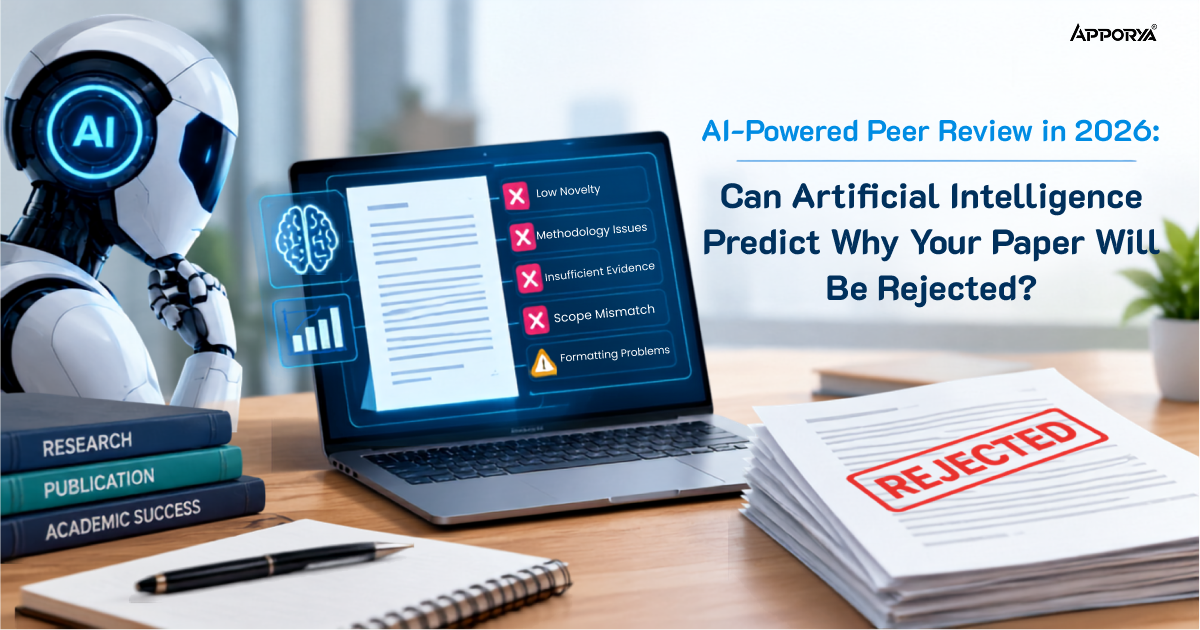
AI can potentially identify risk factors associated with rejection.
For example:
- journal scope mismatch,
- weak abstract,
- incomplete methodology,
- inconsistent references,
- unclear contribution,
- poor reporting.
But “risk assessment” is not the same as predicting the editor’s decision.
Editors consider context.
Two papers with similar technical weaknesses may receive different decisions depending on:
- journal priorities,
- reviewer expertise,
- novelty,
- field developments,
- readership,
- and editorial judgment.
Therefore, researchers should treat AI-based assessments as pre-submission diagnostics, not predictions carved in stone.
Why Human Review Still Matters
Scientific peer review involves judgment.
A reviewer may notice that:
“The result is statistically significant, but the practical significance is limited.”
That is not simply a grammar problem.
It requires domain understanding.
Similarly, a reviewer may recognize that:
- the selected benchmark is inappropriate,
- the comparison method is outdated,
- the experimental design creates bias,
- or the conclusion extends beyond the evidence.
These are scientific judgments.
AI Can Also Be Wrong
This is an important point.
AI systems can produce:
- false positives,
- false negatives,
- incorrect methodological suggestions,
- inaccurate references,
- or overly confident conclusions.
Therefore, an AI manuscript review should never become:
AI says it’s good → submit.
A better workflow is:
→
Expert review
→
Author revision
→
Journal submission
What Researchers Should Do Before Peer Review
You can perform your own “reviewer simulation.”
Question 1: What Is the Main Contribution?
Can a reviewer understand it within the first few minutes?
Question 2: What Is the Research Gap?
Is it specific rather than generic?
Question 3: Is the Methodology Defensible?
Can you justify every major methodological choice?
Question 4: Are the Results Supported?
Do the conclusions match the evidence?
Question 5: What Are the Limitations?
Have you acknowledged them honestly?
Question 6: Why This Journal?
Does the paper genuinely belong in this journal?
AI Should Not Be Used Carelessly With Confidential Manuscripts
There is another side to AI-powered review.
Researchers sometimes upload manuscripts to public AI systems for feedback.
That can create confidentiality concerns.
A manuscript submitted to a journal is unpublished intellectual work.
Similarly, reviewers should not casually upload confidential manuscripts into public generative AI systems.
Publisher guidance emphasizes confidentiality in peer review, and Elsevier specifically warns reviewers and editors against uploading confidential manuscripts into generative AI tools.
Always understand the privacy terms of the tool you use.
How Apporya Can Fit Into This New Publishing Environment
Researchers do not necessarily need another automated tool.
They often need someone who can ask:
“Why did you choose this method?”
“Does this conclusion actually follow from your results?”
“What will a reviewer challenge here?”
That is where human research support remains valuable.
Apporya’s publication assistance includes manuscript enhancement, research-gap strengthening, citation checking, data validation and reviewer-comment support.
Explore Apporya’s Publication Assistance Services
The Future of Peer Review Is Likely to Be Hybrid
The likely future is not:
AI vs humans.
It is:
AI + human expertise.
AI can handle repetitive checks.
Researchers can use AI to identify potential weaknesses.
Expert reviewers can focus more heavily on scientific interpretation, significance and validity.
Editors can use technology to manage increasingly large submission volumes.
But accountability remains human.
Final Thoughts
AI may become increasingly good at identifying obvious weaknesses in manuscripts.
It may even become useful for predicting certain publication risks.
But publishing research is not a simple quality-control exercise.
A paper is more than a collection of sentences, references and statistical results.
It represents an argument about knowledge.
That requires judgment.
So don’t ask only:
“Can AI predict whether my paper will be rejected?”
Ask the more useful question:
“What would a demanding reviewer challenge in my paper—and have I addressed it before submission?”
That question can make a much bigger difference to your publication journey.