Artificial Intelligence Is Changing Research – But Not Always for the Better
Over the last two years, artificial intelligence has become deeply integrated into academic research workflows. What once sounded futuristic is now part of everyday research activity. PhD scholars use AI tools to summarize papers, generate citations, identify themes, organize references, and even draft sections of literature reviews within minutes.
For many researchers, especially those struggling with time pressure, publication deadlines, or the overwhelming volume of academic literature, AI feels like a breakthrough solution.
And to some extent, it is.
AI tools can significantly improve efficiency when used correctly. They can help researchers discover relevant studies faster, simplify complex information, and reduce repetitive manual work. But there is also a growing problem emerging across universities and journals in 2026:
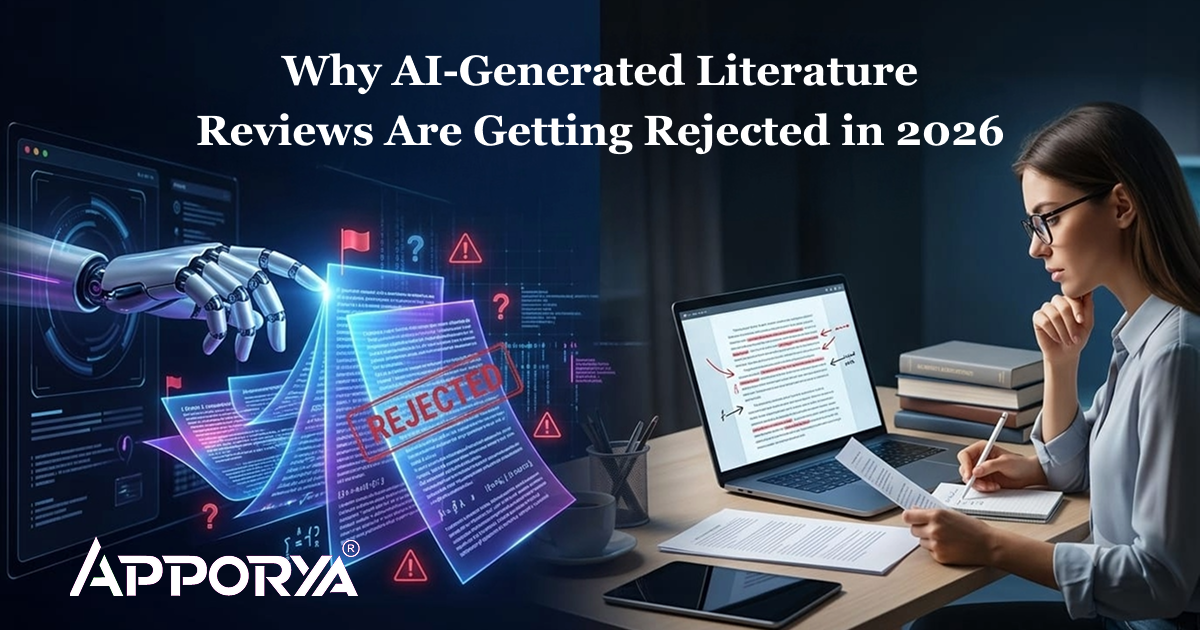
Many AI-generated literature reviews are being rejected.
Editors and reviewers are increasingly noticing patterns in AI-assisted writing that affect the quality, originality, and academic depth of research papers. In some cases, scholars are unintentionally submitting literature reviews that appear polished on the surface but lack genuine academic analysis underneath.
The issue is not simply “using AI.”
The issue is depending on AI without academic interpretation.
As journals tighten their standards and peer reviewers become more aware of AI-generated patterns, researchers now face a new challenge: learning how to use AI intelligently without compromising the integrity of their work.
The Growing Dependence on AI in Academic Writing
The pressure on research scholars today is enormous. Researchers are expected to publish faster, review hundreds of papers, stay updated with rapidly evolving fields, and maintain high academic quality at the same time.
This is exactly why AI tools became popular so quickly.
Instead of manually reading dozens of articles for weeks, scholars can now ask AI systems to:
- summarize research papers,
- identify research trends,
- compare studies,
- generate thematic groupings,
- paraphrase content,
- and draft review sections.
For a busy scholar, this feels incredibly convenient.
A literature review that previously took months to organize can now appear “complete” in a single afternoon. But speed often creates an illusion of quality.
Many researchers assume that if the writing sounds professional, the content must also be academically strong. Unfortunately, reviewers are discovering that this is not always true.
A literature review is not simply a collection of summarized studies. It is supposed to demonstrate critical understanding, intellectual synthesis, and the researcher’s ability to identify meaningful gaps in existing knowledge.
AI can imitate academic language surprisingly well.
What it still struggles with is academic reasoning.
That difference is becoming very visible in journal submissions.
Why Journals Are Becoming More Cautious About AI-Assisted Writing
In 2026, journal reviewers are not necessarily against AI tools. Many academics themselves use AI in limited and ethical ways. However, reviewers are becoming cautious because they are seeing a noticeable increase in manuscripts with similar problems.
These papers often contain:
- generic explanations,
- repetitive sentence structures,
- weak critical analysis,
- inaccurate references,
- and overly broad conclusions.
The language may appear fluent, but the intellectual contribution feels shallow.
Reviewers can often sense when a literature review has been constructed primarily through AI-generated summaries rather than genuine academic engagement. The writing may flow smoothly, yet fail to answer deeper questions such as:
- What is the actual research gap?
- Why do certain findings conflict?
- Which methodologies are more reliable?
- How has the field evolved over time?
- What theoretical limitations still exist?
These are the elements that define a strong literature review.
AI tends to summarize information horizontally. Academic researchers are expected to analyze it vertically.
That distinction matters.
The Hidden Problems Inside AI-Generated Literature Reviews
One of the biggest misconceptions among researchers is believing that literature reviews are mainly descriptive. In reality, strong reviews are analytical.
AI tools are very effective at producing descriptions. They can explain what previous studies discussed. But they often struggle to explain why those findings matter in a broader academic context.
As a result, many AI-assisted literature reviews suffer from several hidden weaknesses.
Lack of Critical Depth
A common issue is the absence of intellectual evaluation.
AI can summarize ten papers in seconds, but it rarely challenges the assumptions behind those studies. It may present all findings equally, even when some studies are outdated, methodologically weak, or contradictory.
Human researchers are expected to critically assess literature, not merely report it.
Reviewers immediately notice when a literature review reads like an organized summary instead of an analytical discussion.
Artificial Coherence Without Real Understanding
Another problem is what many editors describe as “surface-level coherence.”
AI-generated content often sounds academically polished because the sentences connect smoothly. However, the actual reasoning underneath may be weak or repetitive.
The writing appears structured, but the argument itself lacks progression.
For example, AI may repeatedly state that:
- “Previous studies highlight the importance of…”
- “Several researchers have focused on…”
- “The findings suggest that…”
These statements sound formal but contribute very little analytical value.
Over time, reviewers begin recognizing these patterns.
Fabricated or Inaccurate References
This remains one of the most serious concerns.
Some AI tools generate references that look authentic but do not actually exist. In other situations, the citation may be real while the summarized findings are inaccurate or misleading.
Researchers who rely heavily on automated outputs without verification risk introducing false information into their manuscripts.
For journals, this is a major red flag because academic publishing depends heavily on reliability and traceability.
Even a few inaccurate citations can damage the credibility of an entire paper.
Missing Research Gaps
Perhaps the biggest weakness of AI-generated literature reviews is the inability to identify meaningful research gaps.
A genuine research gap is not simply “something that has not been studied.” It requires contextual understanding of:
- existing methodologies,
- unresolved debates,
- theoretical limitations,
- geographical constraints,
- and emerging trends.
AI tools often generate very generic research gaps such as:
“More studies are needed in this area.”
This is not enough for high-quality academic publishing.
Strong research gaps require interpretation and originality — something that still depends heavily on human academic thinking.
Reviewers Are Learning to Detect AI Patterns
In earlier stages of AI adoption, many scholars believed AI-generated writing would be difficult to identify. That assumption is changing quickly.
Experienced reviewers are becoming increasingly familiar with AI-assisted writing styles. Detection is not always based on software alone. In many cases, human reviewers identify patterns naturally while reading.
Some of the most common signals include:
- repetitive phrasing,
- excessive generalization,
- lack of argumentative depth,
- abrupt transitions,
- vague conclusions,
- and unusually uniform writing tone.
Ironically, AI-generated literature reviews often appear “too balanced.” They summarize everything politely without taking analytical positions or exploring tensions between studies.
Human academic writing usually contains more intellectual nuance.
Researchers compare perspectives, challenge assumptions, and emphasize methodological differences. AI-generated reviews often flatten those complexities into smooth but generic summaries.
That is why many reviewers describe AI-assisted writing as technically readable but academically unconvincing.
Ethical AI Use in Research Is Still Possible
Despite these concerns, AI itself is not the enemy of academic research.
The problem begins when researchers expect AI to replace scholarly thinking rather than support it.
Used responsibly, AI can still be extremely valuable throughout the research process.
For example, AI tools can help scholars:
- organize large volumes of literature,
- identify recurring themes,
- simplify technical language,
- generate preliminary summaries,
- improve readability,
- and speed up information discovery.
These are productive uses of technology.
The key is understanding that AI should assist intellectual work — not substitute it.
A strong literature review still requires:
- interpretation,
- synthesis,
- critical comparison,
- theoretical understanding,
- and originality.
Those elements come from the researcher, not the algorithm.
What a Strong Literature Review Actually Looks Like in 2026
In today’s academic environment, journals are looking for literature reviews that demonstrate genuine scholarly engagement.
A high-quality literature review is no longer judged simply by the number of citations included. Reviewers want to see whether the researcher truly understands the field.
Strong literature reviews usually:
- connect studies logically,
- evaluate strengths and weaknesses,
- identify contradictions,
- explain methodological differences,
- and clearly justify the need for new research.
Most importantly, they sound intellectually human.
They reflect curiosity, interpretation, and analytical thinking rather than automated compilation.
Researchers who combine AI efficiency with human reasoning are currently producing the strongest academic work.
A Smarter Way to Use AI in Literature Reviews
Instead of asking AI to “write the literature review,” scholars should use AI more strategically.
For example:
- Use AI to discover relevant papers quickly.
- Use it to organize themes or classify topics.
- Use it to simplify complex terminology.
- Use it to compare large datasets of articles.
But after that, the researcher must take control.
Read the original papers
Verify every citation
Challenge the findings
Interpret the implications
Develop your own academic voice
This hybrid approach is becoming the most effective research workflow in 2026.
The scholars producing the best work are not avoiding AI completely. They are simply refusing to outsource their thinking to it.
The Future of Academic Writing Will Depend on Balance
AI is not disappearing from academia. In fact, its role will continue growing across research, publishing, and higher education.
But as AI becomes more common, originality and authentic academic reasoning will become even more valuable.
Journals are adapting. Universities are updating ethical guidelines. Reviewers are becoming more experienced in identifying shallow AI-assisted content.
This means researchers must evolve as well.
The future does not belong to scholars who reject AI entirely.
It also does not belong to those who blindly depend on it.
It belongs to researchers who understand how to combine technological efficiency with genuine intellectual contribution.
That balance is what academic publishing increasingly demands.
Final Thoughts
AI has transformed the way literature reviews are created, but it has also exposed a growing misunderstanding about what academic research truly requires.
A literature review is not just about gathering information. It is about interpreting knowledge, identifying gaps, and contributing meaningful academic insight.
AI can support that process.
It cannot replace it.
As journals become stricter in 2026, researchers who rely entirely on AI-generated writing may continue facing rejection. Meanwhile, scholars who use AI thoughtfully – while maintaining critical thinking and originality – will stand out more than ever.
In the end, successful research is not defined by how quickly content is generated.
It is defined by the depth of understanding behind it.