Finishing a research paper feels like the hardest part of academic publishing.
For many researchers, it is also the moment when another question appears:
“Is my manuscript actually ready to submit?”
The answer is not always obvious.
A paper can be complete without being publication-ready.
You may have finished the literature review, completed the experiments, analyzed the data, written the discussion and formatted the references. Yet the manuscript may still have weaknesses that an editor or reviewer notices within the first few minutes of evaluation.
Sometimes the problem is obvious, such as a missing section or incorrect reference format.
Other times, the problem is much deeper:
- The research gap is not clearly established.
- The methodology does not adequately answer the research question.
- The journal is not a good fit.
- The conclusions go beyond the evidence.
- Important recent studies are missing.
- The manuscript does not follow the journal’s submission requirements.
- The paper has never been critically reviewed by someone who was not involved in writing it.
This is why completing a manuscript and preparing a manuscript for submission are two different stages.
A good pre-submission review can identify problems while you still have time to fix them.
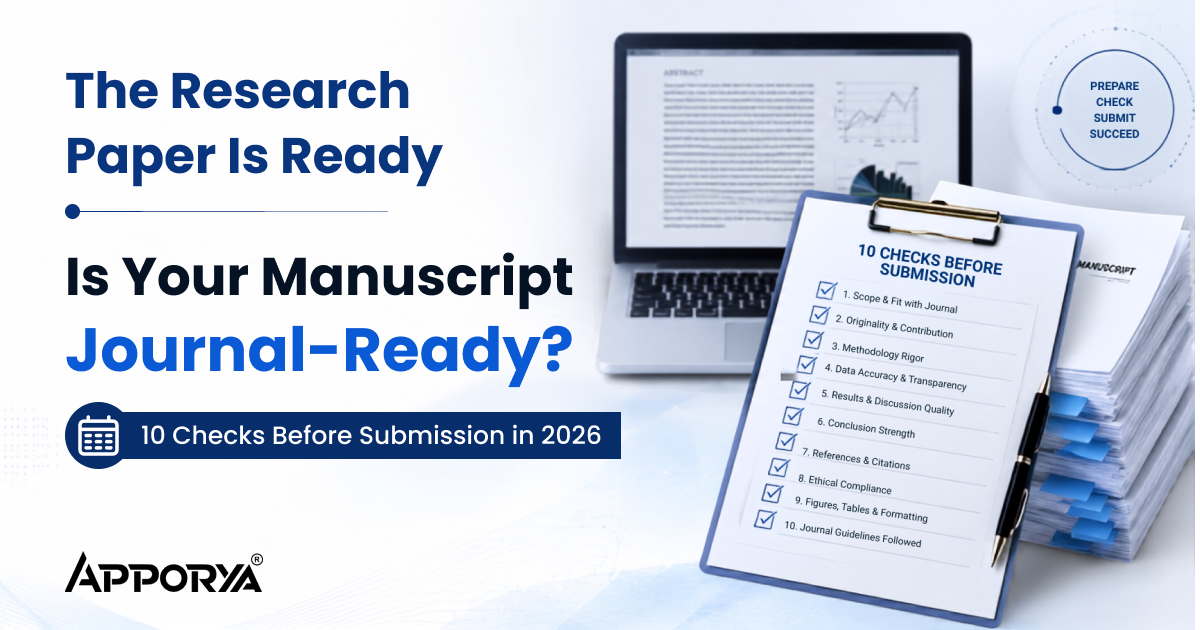
Here are 10 checks every researcher should complete before submitting a research paper in 2026.
1. Can You Explain Your Research Problem Clearly?
Start with the most basic question:
What problem does this paper solve?
If you need several minutes to explain it, the manuscript may need restructuring.
A strong research paper should communicate its central problem relatively quickly.
The reader should understand:
- What is already known?
- What remains unknown?
- Why does the gap matter?
- What does this study investigate?
A common weakness is starting with a very broad introduction.
For example:
“Artificial intelligence has become an important technology across various industries.”
That may be true, but it does not tell the reader what specific problem the research addresses.
A stronger introduction progressively narrows the discussion until it reaches the exact research problem.
Think of the structure as:
Broad field → Specific problem → Existing limitation → Research gap → Objective
If this progression is unclear, revise the introduction before submission.
2. Is Your Research Gap Actually Convincing?
One of the most important questions a reviewer may ask is:
“Why was this study necessary?”
A research gap should not simply mean that nobody has studied exactly the same topic before.
A meaningful gap could involve:
- an unexplored population,
- a methodological limitation,
- conflicting findings,
- insufficient validation,
- an under-researched application,
- an outdated dataset,
- a geographical limitation,
- or a theoretical issue that remains unresolved.
For example:
“Few studies have examined this topic.”
is not necessarily a strong justification.
Instead, explain why the absence of those studies matters.
A convincing research gap connects directly to the research objective and methodology.
3. Does Your Literature Review Demonstrate Critical Thinking?
A literature review should do more than prove that you have read many papers.
It should demonstrate that you understand the research landscape.
Ask yourself:
- Have I included recent and relevant studies?
- Have I included important foundational studies?
- Have I compared different approaches?
- Have I identified disagreements between researchers?
- Have I explained limitations in previous work?
- Does the literature review logically lead to my research gap?
One of the biggest problems with modern AI-assisted literature reviews is that they can become collections of summaries rather than critical analyses.
If you have used AI tools during literature research or writing, verify every important claim and reference independently.
Apporya has covered this issue separately in: Why AI-Generated Literature Reviews Are Getting Rejected in 2026
4. Can You Defend Your Methodology?
A reviewer does not simply want to know what you did.
They want to understand why you did it that way.
Before submission, ask:
- Why was this research design selected?
- Why was this sample size appropriate?
- Why were these variables selected?
- Why was this statistical method used?
- Why was this dataset appropriate?
- How was the model validated?
- Could another researcher reproduce the process?
If the methodology section contains unexplained decisions, strengthen it.
A sophisticated research question cannot compensate for a methodology that does not adequately address it.
This is also where researchers should be careful with AI-generated methodological suggestions.
AI can explain statistical methods or help with coding, but researchers should verify that the selected approach is scientifically appropriate for their specific study.
5. Are Your Data and Statistical Analysis Appropriate?
A manuscript may have an interesting research question and still face rejection because of analytical problems.
Before submission, check:
- Were missing values handled appropriately?
- Are the statistical tests suitable?
- Were assumptions checked where required?
- Are sample sizes adequate?
- Are confidence intervals or effect sizes reported where appropriate?
- Are tables consistent with the results?
- Do figures accurately represent the data?
- Are statistical claims supported by the analysis?
Do not rely solely on whether software produced a statistically significant result.
A p-value does not automatically make a research conclusion meaningful.
Researchers should interpret statistical findings in the context of:
- research design,
- effect size,
- uncertainty,
- practical significance,
- and existing literature.
6. Do Your Results Actually Support Your Conclusions?
This is one of the most important pre-submission checks.
Read your Results and Conclusion sections separately.
Then ask:
“Have I claimed more than my data demonstrates?”
For example, if a study identifies an association between two variables, the conclusion should not automatically claim that one variable causes the other unless the research design supports a causal interpretation.
Watch for words such as:
- proves,
- guarantees,
- causes,
- always,
- completely,
- significantly improves,
when the evidence does not justify such strong language.
A strong paper is not afraid of carefully stated conclusions.
In fact, acknowledging limitations often makes the research more credible.
7. Is This Really the Right Journal for Your Manuscript?
Journal selection should happen before submission-not after rejection.
A journal may appear attractive because it has:
- a high impact factor,
- a well-known publisher,
- a large readership,
- or a prestigious reputation.
But prestige alone does not mean it is the right journal.
Before submission, evaluate:
|
1
Scope
Does your research genuinely fit the journal?
|
2
Recent Publications
Has the journal recently published work similar to yours?
|
|
3
Audience
Are the researchers who would benefit from your work actually reading this journal?
|
4
Article Types
Does the journal accept your manuscript type?
|
|
5
Methodological Expectations
Does the journal publish research using your methodology?
|
6
Publication Policies
Are you comfortable with the journal’s submission, ethical and publication requirements?
|
A strong manuscript submitted to the wrong journal can still receive a desk rejection.
8. Have You Followed the Journal’s Author Guidelines?
This sounds simple.
Yet it is one of the easiest things to overlook.
Different journals may have different requirements for:
- manuscript structure,
- word count,
- abstract format,
- reference style,
- figures,
- tables,
- supplementary files,
- graphical abstracts,
- author contribution statements,
- ethics declarations,
- conflict-of-interest statements,
- data availability statements,
- and AI disclosure.
Do not assume that formatting the manuscript according to another journal’s requirements is sufficient.
Always download and review the current author guidelines for your target journal immediately before submission.
9. Have You Verified Every Reference?
Before submitting, check your references carefully.
Look for:
- incorrect author names,
- incorrect article titles,
- incorrect journal names,
- incorrect publication years,
- broken DOI information,
- missing references,
- references cited in the manuscript but absent from the bibliography,
- bibliography entries that are never cited.
This is particularly important if AI tools were involved in literature research or reference generation.
AI systems can produce references that appear legitimate but contain inaccurate information.
The safest process is:
Reference found → Original article located → Details verified → Citation added
Do not treat an AI-generated reference list as a verified bibliography.
10. Has Someone Critically Reviewed the Manuscript Before Submission?
This may be the most valuable check of all.
Researchers are often too close to their own manuscripts.
After working on the same paper for months, it becomes difficult to notice:
- missing explanations,
- unclear assumptions,
- repetitive arguments,
- weak transitions,
- unsupported conclusions,
- methodological gaps,
- or sections that make sense only because you already know the research.
A fresh reviewer can identify problems you have stopped seeing.
This does not necessarily mean asking someone to proofread the grammar.
You need someone who can critically examine the manuscript from a researcher’s or reviewer’s perspective.
Ask them:
“If you were a journal reviewer, what would you challenge in this paper?”
That question can reveal far more than simply asking:
“Does the paper look okay?”
What About AI Before Manuscript Submission?
AI can be useful during the final preparation stage.
Researchers may use appropriate AI tools for:
- language improvement,
- grammar checking,
- identifying repetitive wording,
- organizing sections,
- generating preliminary questions for self-review,
- coding assistance,
- and other permitted tasks.
But AI should not become the final authority on whether a manuscript is scientifically ready.
A manuscript can receive excellent language feedback and still have:
- a weak research question,
- inappropriate methodology,
- unsupported conclusions,
- or poor journal fit.
This is why AI-assisted editing and expert manuscript review serve different purposes.
For more guidance, see:
AI-Assisted PhD Research in 2026: What Scholars Should and Should NOT Use AI For The 15-Minute Pre-Submission Test
|
01 RESEARCH
What are you actually contributing?
What is the problem? |
02 METHODOLOGY
Can you justify your approach?
Why did I use this method? |
|
03 RESULTS
What does the evidence really show?
What is my most important finding? |
04 JOURNAL
Why should this journal publish it?
Why is this the right journal for my research? |
|
05 INTEGRITY
Can every part of the paper be trusted?
Are my references verified? |
06 QUALITY
Has someone challenged your manuscript?
Has someone independent critically reviewed the manuscript? |
If you struggle to answer several of these questions, consider revising before submission.
What Happens If You Submit Too Early?
Submitting early can feel attractive.
You may think:
“The reviewer will tell me what needs to be changed.”
But peer review is not supposed to replace basic manuscript preparation.
Reviewers should evaluate the scientific contribution-not discover fundamental problems that the author could have addressed before submission.
Submitting too early can result in:
- desk rejection,
- major revisions,
- unnecessary review cycles,
- delayed publication,
- or rejection after months of waiting.
A pre-submission review can therefore save considerably more time than it takes.
What Does a Professional Pre-Submission Review Include?
A useful manuscript review should look beyond grammar.
Depending on the research and service required, it may evaluate:
- research objectives,
- research gap,
- literature review,
- methodology,
- data analysis,
- results,
- discussion,
- conclusion,
- references,
- journal suitability,
- formatting,
- publication ethics,
- and submission requirements.
The goal is not to guarantee acceptance.
No ethical research-support provider can guarantee that a journal will accept a manuscript.
The goal is to make the manuscript stronger, clearer and better aligned with the journal before submission.
When Should You Get Professional Publication Support?
Professional support can be particularly useful when:
- you are submitting to a journal for the first time,
- your manuscript has already been rejected,
- you are unsure whether the research gap is strong enough,
- your statistical analysis needs expert evaluation,
- you are uncertain about journal selection,
- your manuscript requires substantial academic editing,
- or you want an independent pre-submission assessment.
Apporya provides research and publication support covering areas such as research methodology, data analysis, academic writing, manuscript preparation and publication assistance.
Final Manuscript Submission Checklist
Before submitting, make sure you can check all of the following:
- Research problem is clearly defined
- Research gap is specific and justified
- Research objectives are aligned with the gap
- Literature review is current and critical
- Methodology is appropriate and defensible
- Data analysis is suitable
- Results are accurately presented
- Conclusions are supported by evidence
- Limitations are acknowledged
- Target journal matches the manuscript
- Author guidelines have been followed
- References have been verified
- Figures and tables are accurate
- Ethical declarations are complete
- AI-use requirements have been checked
- Manuscript has received an independent critical review
Frequently Asked Questions
What is a manuscript submission checklist?
A manuscript submission checklist is a structured set of checks researchers can use before submitting a paper to a journal. It typically covers research quality, methodology, references, formatting, ethics, journal suitability and submission requirements.
How do I know if my research paper is ready for submission?
Your paper is more likely to be submission-ready when the research gap is clear, methodology is defensible, results support the conclusions, references are verified, the manuscript follows the target journal’s guidelines and the paper has been critically reviewed.
Should I submit my paper before it is perfect?
A paper does not need to be perfect. However, researchers should resolve major scientific, methodological, structural and compliance issues before submission. Waiting for perfection and submitting prematurely are both unnecessary extremes.
Can AI check whether my manuscript is ready?
AI can help identify language, structure and some consistency issues. However, it should not replace expert evaluation of research methodology, originality, scientific reasoning and journal suitability.
What is the biggest mistake researchers make before journal submission?
One of the biggest mistakes is treating manuscript completion as submission readiness. A finished paper still needs a final assessment of research quality, journal fit, formatting, references, ethics and reviewer expectations.
Conclusion
Submitting a research paper should not be the moment when you discover whether the manuscript is ready.
That work should happen before submission.
A strong pre-submission process gives researchers an opportunity to identify weaknesses while they can still be corrected.
The most important question is not:
“Have I finished writing the paper?”
It is:
“If a critical reviewer reads this manuscript tomorrow, can I defend every major decision I have made?”
If the answer is yes, you are much closer to being journal-ready.
And if the answer is no, that does not mean the research has failed.
It means you have found the problems at the right time-before the journal does.